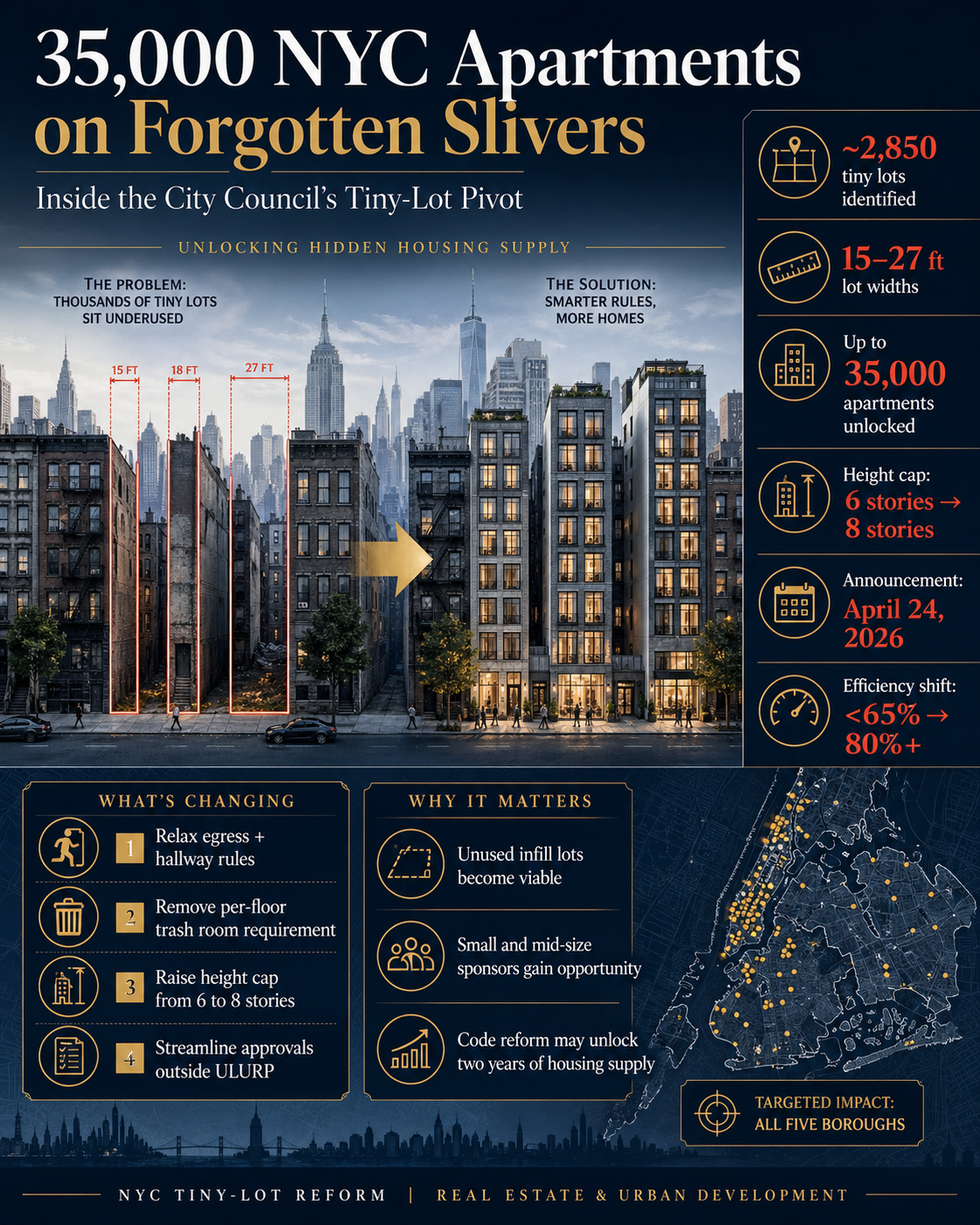
There are roughly 2,850 small lots scattered across New York City — most between 15 and 27 feet wide, vacant or non-residential — that have been quietly killing themselves on the spreadsheet for decades. Too narrow for conventional construction. Too encumbered by code to pencil. Too small for the big dogs to bother with.
On April 24, 2026, Council Speaker Julie Menin stood at an American Institute of Architects event in Lower Manhattan and signaled that’s about to change. The headline number: up to 35,000 new NYC apartments if the city can crack the code on tiny-lot development.
If you build, finance, or invest in NYC housing, this is the most operationally important pro-housing announcement since “City of Yes.” Here’s why.
🎯 The Setup: Why Tiny Lots Have Been Dead Inventory
Walk almost any block in Manhattan, the Bronx, or central Brooklyn and you’ll find them — narrow gaps between townhouses, leftover sliver parcels from old assemblages, vacant lots that have sat fenced and weed-covered since the 1970s. They are not unbuildable in theory. They are unbuildable in economics.
The killers, in order of pain:
– Two-stair egress requirements force bulky cores that consume a brutal share of rentable floor plate at narrow widths
– Trash room requirements per floor burn another 100+ sf of usable space on every level
– Hallway widths and emergency exits designed for mid-block prewar buildings
– Six-story height caps on certain narrow-lot zoning that arbitrarily reduce yield
Stack those constraints on a 17-foot-wide lot and you end up with a building where net-to-gross efficiency drops below 65%. No private sponsor underwrites that.
Result: 2,850 lots producing zero housing.
🏛️ What’s Actually Being Proposed
The Council’s working group is co-chaired by three names worth tracking:
– Gary LaBarbera, president of the Building and Construction Trades Council — labor’s voice in the room
– Barika Williams, Association for Neighborhood and Housing Development — affordable housing advocacy
– James Simmons III, CEO and founder of Asland Capital Partners — institutional minority developer with real on-the-ground experience
That trio — labor, advocacy, sponsor capital — is a deliberate political construction. It signals the Council wants this to read as **bipartisan within the housing coalition**, not as a developer giveaway.
The provisions on the table, per Menin:
1. Modify emergency exit and hallway requirements for narrow lots
2. Eliminate the per-floor trash room requirement
3. Raise the height ceiling from 6 to 8 stories on eligible parcels
4. Streamline approvals to dodge the ULURP and special permit gauntlet
Those four changes, if implemented, can flip a tiny-lot project from a 65% efficient money-loser into something north of 80% efficient — which is when the math starts working at market rents.
> “Outdated rules and unnecessary red tape” are stalling development, the Speaker argued. The translation: the building code is doing what zoning fixes alone can’t reach.
⚠️ The Tension: Affordable Housing Mandate Is Conspicuously Absent
Here is what the Speaker did not say: that the resulting units will be required to be affordable.
That is going to be the next fight. Mayor Zohran Mamdani’s administration is already in “early talks” with the Council, per the article. Mamdani campaigned on aggressive affordability mandates — Mandatory Inclusionary Housing (MIH) extended to as-of-right contexts, deeper income targeting, longer affordability terms.
The Speaker’s framing — code reform, not zoning reform — is a clear effort to keep this out of the MIH/ULURP/full rezoning machine, where it would die in two years of community board fights. Code changes can move through Department of Buildings and City Council without triggering the same political process.
That speed is a feature for sponsors. It is a bug for advocates who want every unlock to come with a deeper affordability commitment.
Watch this fight closely. It will determine whether tiny-lot reform produces 35,000 market-rate apartments, 35,000 income-restricted apartments, or — most likely — a mixed regime that depends on neighborhood and lot ownership.
📊 The Numbers That Matter
| Metric | Value |
|---|---|
| Tiny lots identified | ~2,850 |
| Lot width range | 15–27 feet |
| Potential units unlocked | up to 35,000 |
| Current height cap | 6 stories |
| Proposed height cap | 8 stories |
| Date announced | April 24, 2026 |
For context: 35,000 units is roughly two years of NYC’s normal residential delivery pipeline. Producing that on existing infill lots — with no new acquisition cost in many cases — is the closest thing to free housing supply the city has ever proposed.
🏗️ What This Means for Sponsors
Three takeaways if you’re underwriting NYC ground-up residential right now:
1. Start mapping tiny lots in your target markets immediately
This program will move from announcement to enabling legislation faster than zoning reform. The sponsors who already have site control on 17-foot lots in the Bronx, Inwood, East Harlem, Crown Heights, and Bed-Stuy will eat first. PLUTO and ACRIS pulls are cheap. Run them this week.
2. The “Big Ideas Small Lots” lesson is real
The 2019 HPD/AIA design competition produced beautiful tiny-lot prototypes — and zero sponsors built any of them. The reason was always the code. If the code changes, the prototypes are sitting there ready. Architects who participated in that competition (and the firms that hired them after) just became more valuable.
3. Construction labor is at the table this time
LaBarbera’s co-chair role is not decorative. The Building and Construction Trades Council will want prevailing wage thresholds attached to anything above a certain unit count. If you’re underwriting non-union, model both scenarios.
🚀 The Operator’s Call to Action
This is rare in NYC: a pro-supply policy gesture that doesn’t require zoning, doesn’t require ULURP, and doesn’t require a developer to win a community board vote. The mechanism — code reform — is unsexy, technical, and exactly the kind of change that can actually ship.
If you operate in NYC ground-up housing, do three things in the next 30 days:
1. Pull a PLUTO/ACRIS list of vacant lots 15–27 feet wide in your target neighborhoods
2. Engage an architect who participated in the 2019 Big Ideas Small Lots competition (or hire someone who studied the prototypes)
3. Track the enabling legislation — when the bill drops in committee, that is your acquisition signal
Tiny-lot reform won’t make the next New York Times cover. It will make a generation of small-to-mid-sized sponsors very, very wealthy.
Want my running list of the 50 best tiny-lot opportunities I’ve identified across the five boroughs? Comment “tiny lot” and I’ll DM the methodology.
#NYCRealEstate #AffordableHousing #ZoningReform #UrbanPlanning #CityOfYes #JulieMenin #NYCDevelopment #InfillDevelopment #SmallLotHousing #CRE #RealEstateDevelopment #NYCHousing #BuildingCode #ULURP