🏛️ Plot Twist: “Anna Delvey” Building for $81.5M — goes to Airbnb
You can’t script this one. The building that fake heiress Anna Sorokin once tried to turn into a private members’ club just sold — to Airbnb, the company that spent a decade upending the very notion of what a “hotel” or a “home” even is.
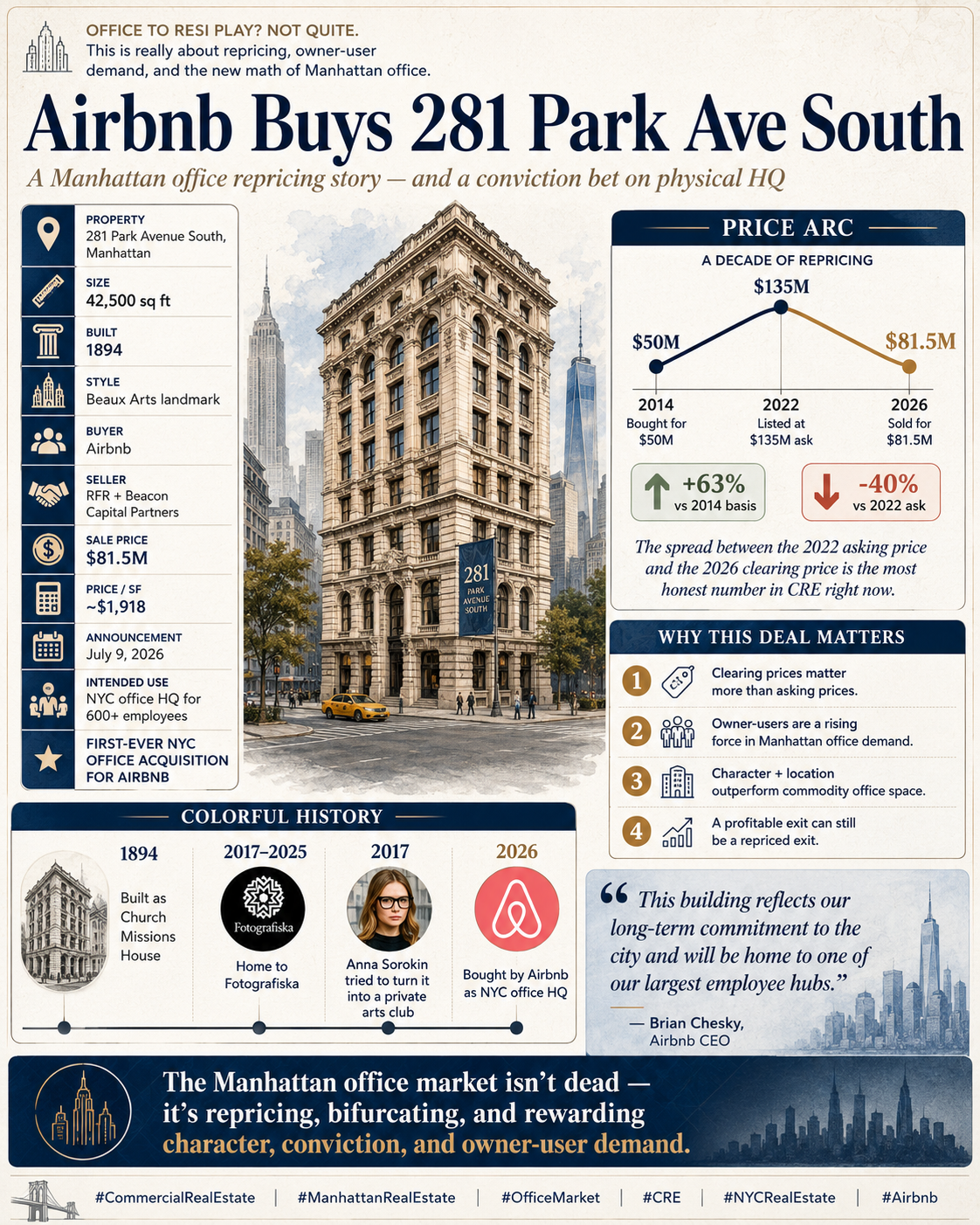
RFR, Aby Rosen’s firm, and partner Beacon Capital Partners sold 281 Park Avenue South — a 42,500-square-foot Beaux Arts landmark built in 1894 — to Airbnb for $81.5 million. It’s Airbnb’s first-ever NYC office purchase, and the company plans to make it a headquarters hub for 600+ employees.
But look past the celebrity-scammer headline and the irony of the buyer, and you’ll find a deal that’s really a story about repricing, conviction, and the office market’s brutal new math. Let me break down the numbers — because they tell a far more instructive tale than the Netflix trivia.
The Deal By The Numbers
Here’s the transaction stripped to its essentials:
- Property: 281 Park Avenue South, Manhattan
- Size: 42,500 sq ft, built 1894 (originally the Church Missions House)
- Style: Ornate Beaux Arts landmark
- Buyer: Airbnb (its first NYC office acquisition)
- Seller: RFR (Aby Rosen) + Beacon Capital Partners
- Sale price: $81.5 million (~$1,918/sq ft)
- Announcement: July 9, 2026
- Intended use: NYC office HQ for 600+ employees
Now the pricing arc, which is where it gets interesting:
- 2014: RFR bought it for $50 million.
- 2022: Listed with a $135 million asking price — which failed to trade.
- 2026: Sold for $81.5 million.
Read The Price Arc — It’s The Whole Story
That three-number sequence — $50M → $135M ask → $81.5M sale — is a perfect X-ray of the Manhattan commercial cycle.
RFR bought at $50 million in 2014, near the bottom of a different era. By 2022, riding peak valuations and pre-rate-shock optimism, they aimed for $135 million — a near-tripling. The market said no. The building didn’t trade at that number because the world that would have paid it was already gone.
Four years later, it clears at $81.5 million. That’s a 63% gain over the 2014 basis — a perfectly respectable outcome for RFR — but a 40% haircut from the 2022 aspiration. Both things are true at once. The seller made real money and the market repriced the ambition down by tens of millions.
The gap between a 2022 asking price and a 2026 clearing price is the most honest number in commercial real estate right now. It’s the market telling you exactly how much the cost of capital moved.
For anyone underwriting Manhattan office and mixed-use, that spread is the lesson. Aspirational pricing from the cheap-money era is dead. Clearing prices are where the real information lives.
Why Airbnb, And Why This Building, Matters
The buyer identity isn’t just fun trivia — it’s a genuine market signal. Consider what it means that Airbnb — a tech company that could plausibly operate fully distributed — chose to own, not lease, a landmarked Manhattan office for 600+ people.
- It’s a conviction bet on physical HQ. In a post-remote-work debate, one of the world’s most digitally native companies just planted a permanent, owned flag in Manhattan. CEO Brian Chesky framed it directly:
“This building reflects our long-term commitment to the city and will be home to one of our largest employee hubs.” — Brian Chesky, Airbnb CEO
- Owner-users are a rising force in this market. When corporate buyers acquire trophy and boutique office at repriced levels, they change the buyer pool. They’re not underwriting to a cap rate and an exit — they’re underwriting to utility and brand. That’s a different, often higher, bid than a pure financial buyer will make.
- Distinctive, well-located, human-scaled buildings win. A 42,500-SF Beaux Arts landmark near Park Avenue South is the antithesis of the commodity glass box. Character and location are commanding a premium precisely when generic space is struggling.
The Colorful History Is A Feature, Not A Footnote
Let’s not pretend the story doesn’t sell. This building has layers:
- 1894: Built as the Church Missions House.
- 2017–2025: Home to Fotografiska, the Swedish photography museum.
- 2017: Anna Sorokin — the “Anna Delvey” fake heiress — famously tried to lease it and convert it into a private arts club, a scheme that collapsed into one of the decade’s great grifter sagas.
- 2026: Bought by Airbnb as an office HQ.
There’s a real-estate truth inside the tabloid arc: irreplaceable, characterful assets attract irreplaceable attention. From a museum to a would-be private club to a tech HQ, this building keeps drawing marquee users because there’s nothing else quite like it. Scarcity of character is its own asset class.
What Operators Should Take Away
Here’s how I’d translate this deal into your underwriting:
- Trust clearing prices, not asking prices. The $135M-to-$81.5M gap is your market-education moment. Reset your comps to what actually trades.
- Watch the owner-user bid. Corporate buyers acquiring trophy office for their own use are a structural source of demand that pure-yield investors keep underestimating. Factor them into your exit assumptions.
- Character and location are the durable premium. Landmarked, boutique, transit-proximate assets are outperforming the commodity office narrative. Underwrite the specific building, not the sector average.
- A good outcome can still be a repriced outcome. RFR made money and took a haircut from peak. Both are true. Don’t confuse a profitable exit with a validation of peak-cycle pricing.
The Bottom Line
Airbnb buying the “Anna Delvey” building for $81.5 million is the rare deal that’s both a great headline and a great teaching case. Strip away the scammer lore and you’re left with a clean lesson: a 42,500-SF Beaux Arts landmark traded up 63% from its 2014 basis yet 40% below its 2022 dream price — and it took an owner-user tech giant, not a yield-chasing investor, to clear it.
The Manhattan office market isn’t dead. It’s repricing, bifurcating, and rewarding character and conviction. The buyers who understand that — who trust clearing prices and hunt for the irreplaceable — are the ones writing the next chapter.
So here’s my question: When you underwrite Manhattan office today, are you anchoring to the last aspirational asking price you saw — or to what’s actually clearing? And how much weight are you giving the owner-user bid in your exit math? Drop your view below. And if you’re navigating a repricing on a trophy or boutique asset and want a sober read on where it actually clears, my inbox is open. In this market, the honest number wins.