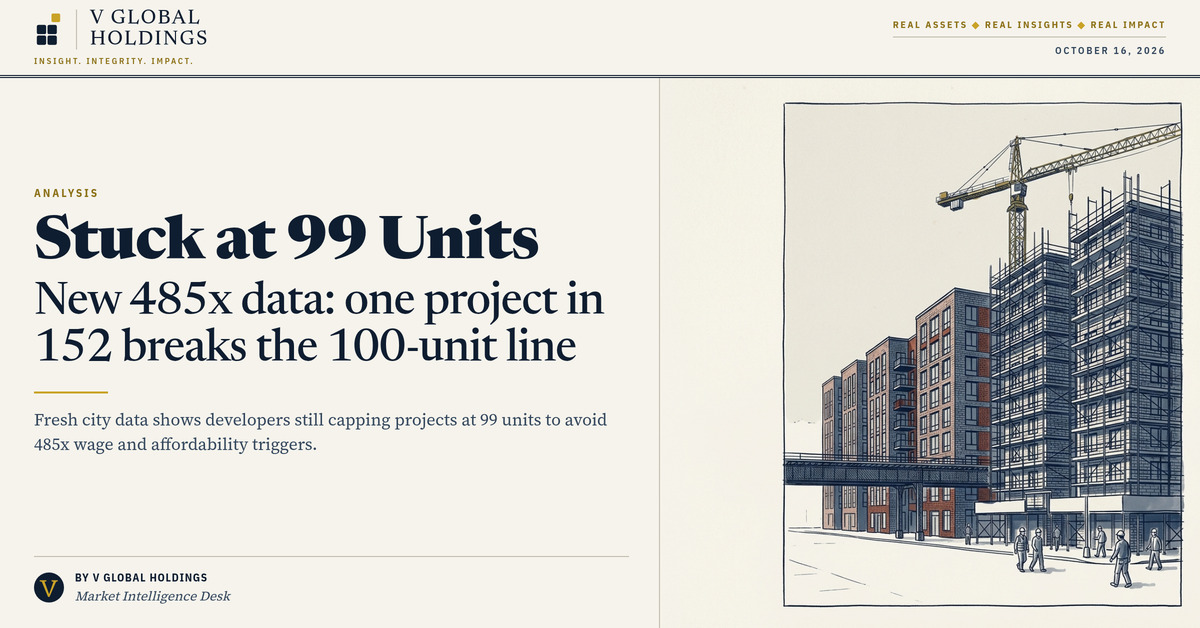
The city just released six more months of 485x data, and the punchline is the same as last time. New York’s developers are still building to 99 units and stopping.
If you underwrite ground-up multifamily, lend on it, or are trying to figure out what Albany does with this program in January, this is the one to read today. Below: the new numbers, the math behind the 99-unit cliff, the workaround developers are using, and what I think operators should be doing before the legislature reconvenes.
The New Numbers
TRD’s Erik Engquist walked through the dump in his Reality Check column. The headline figure comes from a preliminary analysis by Nate Bliss, founder and CEO of Latent Urban Ventures.
- 152 newly registered 485x projects
- 20 of them have exactly 99 units
- Only one has more: BedRock Real Estate Partners and LMXD’s 35-10 Steinway Street in Astoria, slated for 560 units
Zoom out to the whole program and the picture doesn’t improve. Overall, 49 projects of exactly 99 units have registered to use 485x. Just four larger ones have.
Where are the new registrations landing?
| Borough | New 485x projects |
|---|---|
| Bronx | 67 |
| Brooklyn | 51 |
| Queens | 28 |
| Manhattan | 6 |
| Total | 152 |
The Bronx and Brooklyn account for nearly four in five of them. Manhattan barely registers.
Why 99 Is the Magic Number
This isn’t developers being superstitious. The program’s requirements step up at 100 units and again at 150 units, and the steps are steep.
- Wages. Larger projects carry higher mandated labor costs, pushed for by construction and building service worker unions.
- Affordability. Buildings of 100 units or more must set aside 25 percent of residential space as affordable, versus 20 percent in smaller ones.
- Clawback risk. Developers worry that if they go over 99 units and an audit finds they missed a requirement, they lose the entire tax abatement, which would bankrupt the project.
Bliss, who was on the Adams administration team that negotiated the 2024 housing package that created 485x to replace the expired 421-a, put it plainly: “It’s not just the wages. The compliance regime, the clawback of the taxes — there are other things making the program not work.”
And the abatement isn’t optional. TRD notes that without some kind of property tax break, most rental projects don’t pencil.
The Yield-on-Cost Gap
Here is the slide industry leaders have reportedly been showing elected officials in private meetings. Helen Hwang of Meridian Investment Sales modeled an actual 99-unit project:
| Scenario | Projected yield on cost |
|---|---|
| Built at 99 units | 6.1% |
| Same project at 150 units | 5.2% |
That’s a 90 basis point haircut for building more housing on the same site. In my experience, very few equity committees approve a deal that gives up nearly a full point of return to add units. The program is, in effect, paying developers to build less.
The Workaround: Clusters of 99
Developers are, as one attorney put it, agile. TRD reports about a dozen of them are clustering 99-unit buildings on single development sites. One recent filing shows 10 adjacent buildings, all just under 100 units.
“I’m very saddened to see that 485x is incentivizing inefficiencies. Developers are very agile creatures and they adapt to what’s before them.” — YuhTyng Patka, partner, Adler & Stachenfeld
The Building and Construction Trades Council has called this a loophole and asked state legislators to close it. TRD’s read is that this seems unlikely, given the city’s housing shortage.
The cost of the workaround shows up in the floor plans. To use as much allowable square footage as possible while staying under 100 units, developers are building larger apartments and charging higher rents than they otherwise would. Patka again: “You are adding all these extra elevator banks and lobbies. That takes away space that would otherwise be going to housing.”
421-a vs. 485x: The Scale Problem
This is the comparison I’d put in front of every legislator:
- 2010–2020, under 421-a: buildings with 100+ units produced 56% of new residential units
- Under 485x so far: the four large projects account for 9% of registered units
Large buildings used to be the backbone of new rental supply. Under 485x they are a rounding error.
REBNY President Jim Whelan summed it up in a statement: “We cannot solve a housing crisis 99 units at a time.”
Where City Hall Stands
This is where it gets interesting. Back in May, at TRD’s New York Forum, the Mamdani administration said it was too early to call 485x a failure.
“We’re in year two of a 10-year program,” Deputy Mayor Leila Bozorg said. “Everyone needs to adjust to a new program… I do believe it needs more time.”
HPD Commissioner Dina Levy said she had been “very curious to see some really detailed underwriting from developers as to where it’s falling short.”
The industry’s answer is that the results are the underwriting. And this was the final data release before the state legislature reconvenes in January to consider changing the program or creating a new one for larger projects. Because 485x only applies in New York City, TRD notes that support from the Mamdani administration will likely be needed to move state lawmakers.
What I’d Do Now as an Operator
My take, not TRD’s:
- Model both cases. If you’re carrying a site zoned for well over 99 units, underwrite the 99-unit version and the full-build version side by side. If Albany changes the thresholds, you want to be first to file.
- Share real numbers. The commissioner asked for detailed underwriting. Developers who give HPD and their legislators actual pro formas, not talking points, will shape what comes next.
- Watch the cluster strategy. It works today. A legislative fix, in either direction, could change how those sites are treated, so I’d price that risk into any multi-building plan.
- Rethink unit mix. If you’re building to 99, the market is already absorbing larger, pricier units. Know your rent comps before you lock the floor plates.
The Bottom Line
The data is no longer preliminary in spirit, even if Bliss’s analysis is preliminary in name. One project in 152 broke the 100-unit line in this batch. A program meant to drive housing at scale is producing housing in increments of 99.
January is the window. If you build, finance, or design multifamily in this city, now is the time to get your numbers in front of the people writing the next version.
Are you underwriting to 99 units, or have you found a way to make a larger 485x project work? I’d like to hear what’s in your model. Drop it in the comments.