Federal agents reportedly searched a Brooklyn home linked to a dealmaker facing a stack of civil lawsuits, and the allegations at the center of those suits touch something every NYC deal depends on: escrow. No one has been charged. But the questions the reporting raises are ones every operator can answer for their own shop today.
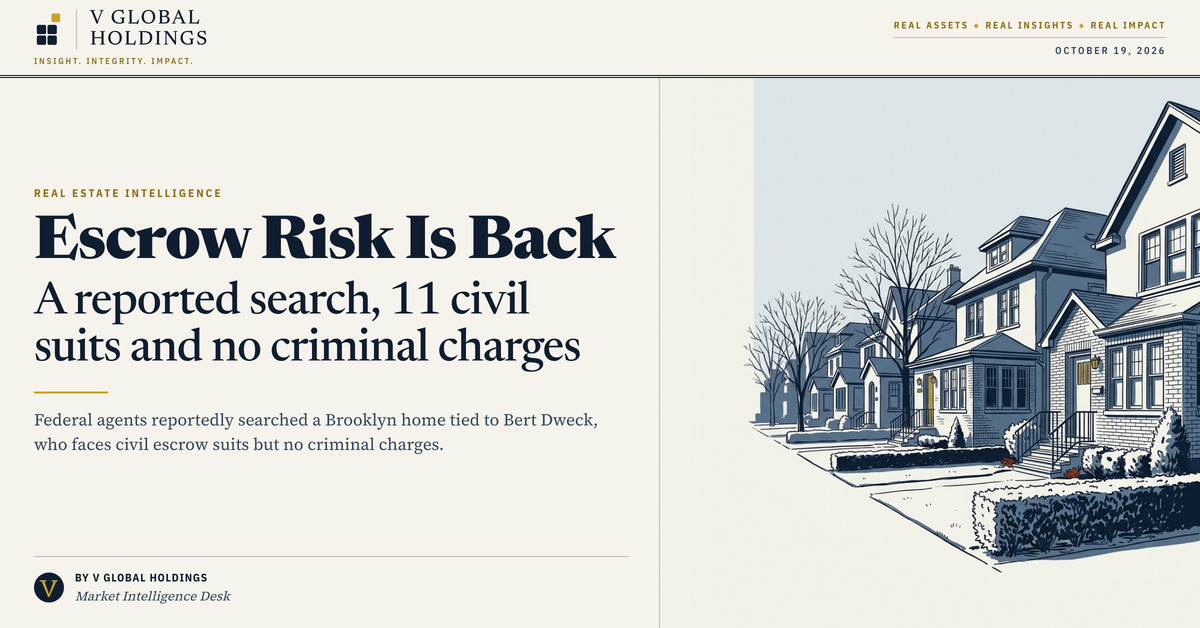
If you close acquisitions, lend on them, or invest alongside sponsors, this post walks through what The Real Deal (TRD) reported, separates reported facts from allegations, and lays out a practical escrow and counterparty diligence checklist.
A note on format. Facts below come from TRD’s reporting. Everything in the lawsuits is an allegation, not a finding. Anything labeled as my view is opinion about diligence, not a claim about what any party did or what investigators are looking at.
What TRD Reported
According to TRD, citing multiple sources, federal agents raided the Midwood home of Bert I. Dweck’s in-laws, where Dweck and his wife, Alyson, are living. Agents searched the home of Alyson’s parents near Avenue J in the early morning of Oct. 6, sources told TRD.
Two points TRD makes plainly matter most. Dweck was not arrested or taken into custody, and no criminal charges have been publicly filed against him. The FBI did not respond to TRD’s requests for comment.
The raid is reported through sources. It is not an announced charge, and it tells us nothing about outcomes.
The Lawsuits Behind the Headline
TRD says the raid follows a string of civil fraud lawsuits filed in New York and New Jersey. Dweck has faced 11 lawsuits, and some of them allege he used phony contracts to solicit funds for real estate acquisitions.
Here is the allegation that matters for our industry. Per TRD, the funds were supposed to be held in escrow accounts, but the lawsuits allege Dweck diverted the money, with some going toward his family’s six-bedroom home in Deal, New Jersey.
Some of the lawsuits also name his parents, Isaac and Marlene Dweck, and his brother, Adam Dweck.
Again: these are claims made by plaintiffs. They have not been proven.
The New Jersey Suit in One Table
TRD describes one New Jersey lawsuit in detail. Here is the reported structure, side by side:
| Item | What the lawsuit alleges (per TRD) |
|---|---|
| Plaintiffs | Steven Tabeek and Joseph Ashkouti |
| Amount loaned | $2.1 million to Bert I. Dweck and his father, Isaac Dweck |
| Timeframe | Between 2024 and 2025 |
| Stated purpose | Buying properties at 4188 Broadway (Manhattan), 1526 Grand Concourse (Bronx) and 6401 Fort Hamilton Parkway (Brooklyn) |
| Alleged flow of funds | Proceeds funneled into a related company, Affinity Development Capital |
| Alleged use | Credit card bills, car payments and expenses tied to the family’s Deal home |
Read that table as a map of where plaintiffs say the money went versus where they say it was meant to go. The gap between “stated purpose” and “alleged use” is the entire dispute.
The Escrow Attorney Angle
TRD also reports that, according to a lawsuit filed in New York state court, Dweck relied on Gravesend-based attorney Jacques Erdos to facilitate the alleged scheme by releasing escrow funds directly to Dweck.
Erdos’ lawyer has previously denied allegations of wrongdoing. That denial belongs in any fair summary of this story.
On the other side of the ledger, TRD reports that when reached by phone, Dweck told TRD to talk to his attorney and declined to comment. His attorney, Jason Swergold, also declined to comment.
TRD adds that after the wave of lawsuits, Dweck and his attorney worked on settling the suits, and many were in the process of being discontinued, according to court filings.
The Bigger Escrow Backdrop
TRD frames this within a wider pattern. Here is the line:
“The Dweck litigation is the second major scandal in New York’s real estate industry involving allegations of missing escrow funds.” (The Real Deal)
The first, per TRD, involves former New York City attorney Mark Nussbaum, who admitted to diverting $336 million from his firm’s escrow accounts. Creditors are now seeking to collect over $400 million from Nussbaum’s former law firms.
Those are very different matters with different facts, and I am not equating them. The point is narrower: escrow risk is back in the conversation, and the market is paying attention.
What Operators Should Take From This
This section is my opinion on diligence practice. It is not a view on the merits of any lawsuit, and it assumes nothing about what any party did.
The common thread in the allegations is simple. Money was supposed to sit somewhere safe, and plaintiffs say it did not. That makes the controls around escrow the part of your process worth stress-testing.
A few questions I would ask on every deal:
- Who actually controls the escrow account? A title company, an institutional agent, or an individual attorney? The answer changes your risk profile.
- What are the release conditions? Written, specific and tied to documents you can verify, or a handshake and an email?
- Who has to sign off on a release? One person, or two parties with independent interests?
- Can you confirm the account independently? Call the institution on a number you sourced yourself, not one supplied in the deal package.
- Do the contracts match reality? If a purchase agreement is the basis for a deposit, verify the seller, the property and the signatories.
A Quick Counterparty Diligence Checklist
For lenders, co-investors and private capital partners, here is how I would organize the work:
- Verify the underlying contract with the counterparty on the other side of it, directly.
- Confirm the property through public records, not only through the sponsor’s summary.
- Trace the flow of funds from wire to closing on paper before you fund, and document it afterward.
- Separate related entities. If proceeds can move to an affiliated company, your documents should say whether that is allowed.
- Run litigation searches on every principal and related party, and read what you find. Eleven suits in two states is a signal worth noticing early, not late.
- Prefer independent escrow agents for deposits and loan proceeds where the deal size justifies the cost.
None of this is exotic. Most of it is already in a good closing checklist. The risk is skipping steps when a deal feels familiar or the relationship feels trusted.
Open Questions I Am Asking
These are questions, not claims:
- How many sponsors and lenders have changed how they handle deposit and escrow controls in the last year?
- Do your side letters and loan documents restrict movement of proceeds to affiliates?
- Would your current process catch a contract that was not what it appeared to be?
TRD’s reporting does not answer these. Your own files might.
The Bottom Line
Here is what is established per TRD: a reported search on Oct. 6, no arrest, no publicly filed criminal charges, 11 civil lawsuits with serious allegations, a denial from Erdos’ lawyer, and no comment from Dweck or his attorney. Everything else is unproven.
What is not in doubt is the lesson for the rest of us. Escrow is only as safe as the controls around it. Trust is not a control. Verification is.
Your Turn
Here is my question for the NYC CRE community. If you had to prove tomorrow that every dollar of deposit or loan proceeds on your current deals sits where your documents say it does, how long would it take your team, and what would you check first?
Tell me how your shop handles escrow and counterparty diligence. Drop it in the comments or send me a DM.
Source: The Real Deal.