A rent control bill died in Jersey City before it was even introduced. On the same news cycle, the mayor announced a tax deal that adds affordable apartments to the towers that started the fight.
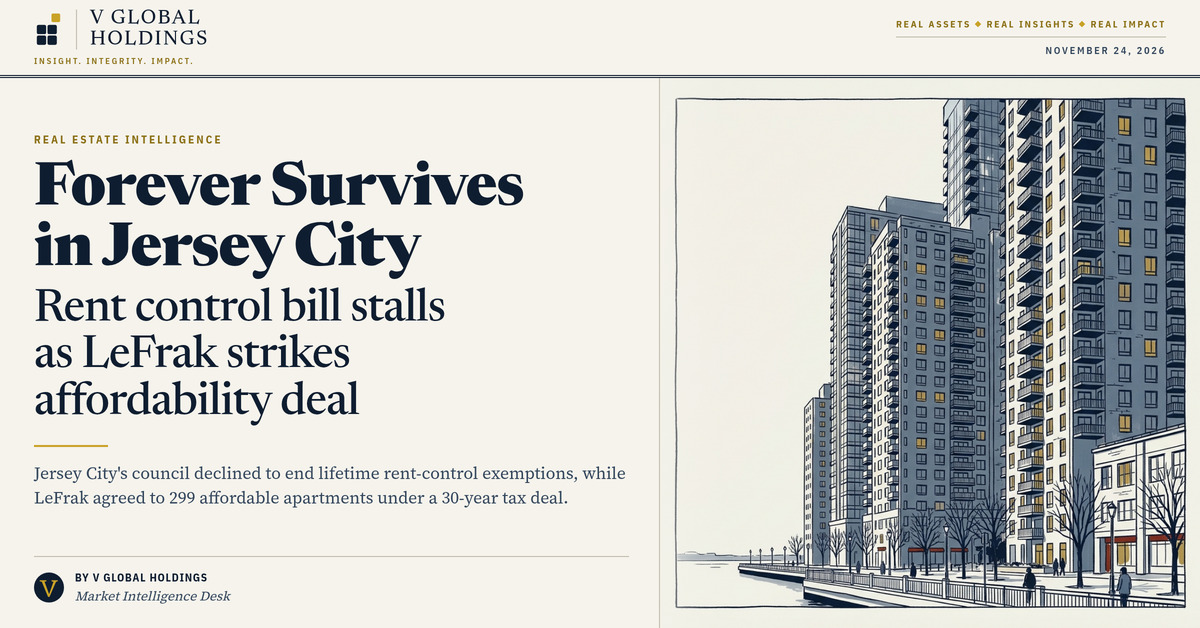
If you own, build or lend on multifamily anywhere in the New York metro, this piece gives you three things: what the proposal would have changed, what the LeFrak agreement trades, and the questions I’d be asking about every incentive in my own portfolio after watching this play out across the Hudson.
What Happened
The Real Deal reported the story on Nov. 23, citing Gothamist. Here is the sequence as TRD lays it out.
Jersey City’s nine-member City Council declined to advance an ordinance sponsored by Councilmember Jake Ephros, a democratic socialist. The ordinance would have eliminated lifetime rent-control exemptions for new developments in designated redevelopment areas.
Only two members backed it: Ephros and fellow socialist Joel Brooks. TRD describes the measure as effectively killed before it could be formally introduced.
“A push to expand rent control in Jersey City hit a political wall, giving developers a reprieve from a proposal that threatened one of the city’s longstanding incentives for high-rise construction.” — The Real Deal, Nov. 23, 2026
Note the word reprieve. Ephros and Brooks have pledged to bring the effort back, and developers say they will oppose any future version.
The Trigger: Presidential Plaza
The bill did not come out of nowhere. It was a response to a looming rent spike at Presidential Plaza, the first residential towers built at Newport, the waterfront master-planned community developed by LeFrak Organization and Simon Property Group.
The mechanics matter, so here they are in order:
- LeFrak paid off the property’s mortgage early this year to finance renovations.
- The affordable housing restrictions at the property were tied to that loan.
- When the loan went away, the restrictions expired with it.
- In September, tenants were told their below-market rents would last for only one more lease before rising to market rates.
Nothing in TRD’s report suggests any of that was improper. An owner retired debt, and a restriction that lived inside the debt ended. But tenants facing market rents on a short clock became the political opening for a much broader proposal.
30 Years vs. Forever
The policy question is narrow and easy to state. How long should new construction stay outside rent control?
| Rule | Exemption from rent control | Applies to |
|---|---|---|
| New Jersey state law | Generally 30 years | New construction |
| Jersey City rules | Lifetime | Projects in designated redevelopment zones |
| Ephros proposal | Would end the lifetime exemption | New developments in designated redevelopment areas |
Each side made its case, per TRD:
- Ephros argued the redevelopment-area exemption has outlived its purpose in neighborhoods that no longer need incentives to attract investment.
- Ben LoPiccolo, head of the Jersey City Apartment Owners Association, argued that high-rise developments need more than 30 years to recover their costs.
- Mayor James Solomon questioned the proposal’s financial implications and warned it could jeopardize tax revenue as the city confronts a fiscal crisis.
That third point is the one that decided it, in my reading. The mayor did not defend the exemption as good housing policy. He defended the tax base. When a city is short on money, the argument that wins is usually the one about revenue.
The Deal That Arrived Alongside the Defeat
The setback for rent control advocates came with a separate announcement. Solomon said his administration reached a payment-in-lieu-of-taxes (PILOT) agreement with LeFrak covering the towers.
The reported terms:
| Term | Detail |
|---|---|
| Affordable apartments today | 272 |
| Affordable apartments under the deal | 299 |
| Net increase | 27 units |
| Lowest rents cited | Some units at $1,000 a month |
| Tax abatement term | 30 years |
| Affordability term | Full 30 years, even if LeFrak ends the exemption early |
| Status | Still requires council approval |
Read the second-to-last row twice. The old restrictions were tied to a mortgage, and they ended when the mortgage was paid off. The new protections are written to survive an early exit from the abatement. The city saw exactly how the last set of restrictions ended and drafted this one so the same move does not work again.
That is the real lesson in the document, and it applies well beyond Jersey City.
My Take as an Operator
Everything above is reported fact from TRD. What follows is my opinion.
I work in New York City, where we know what it looks like when a regulatory regime changes under a building that was underwritten on the old one. Owners here learned that in 2019. So when a city ten minutes away by PATH debates removing a permanent exemption, I do not treat it as somebody else’s problem.
Three things stand out to me.
First, “lifetime” is a political term, and nobody should underwrite it as a contract term. An exemption that exists by local rule can be removed by local vote. This one survived, and the vote was not close. But the sponsors have said they are coming back, and the composition of a council changes. If your exit cap rate assumes free-market rents forever, you are pricing a promise that one ordinance can withdraw.
Second, the fight started at one property. A single mortgage payoff at one set of towers produced a citywide bill. Regulatory risk often starts with a rent notice at a single building and reaches the legislature a few months later.
Third, the negotiated outcome beat the legislated one. LeFrak ends up with a 30-year abatement and 27 more affordable units than before. The city gets durable affordability. The two council members get neither their ordinance nor, so far, a vote. I think owners who come to the table early with something concrete tend to do better than owners who wait to be regulated, and this is a clean example.
Here is the checklist I’d run this quarter on any multifamily asset, in New Jersey or in the five boroughs:
- List every incentive and exemption on the property. Abatements, exemptions, regulatory agreements, zoning bonuses. Write down what each one is worth per year.
- Find what each one is attached to. Is it tied to a loan, a regulatory agreement, a statute or a local ordinance? The answer tells you who can end it and how.
- Map what a refinance or payoff triggers. Before you retire debt, know which restrictions and which benefits ride on that debt.
- Stress the exit. Run the sale with the exemption intact and with it gone at year 30. If the deal only works in the first case, say so in the investment memo.
- Plan the tenant communication before the notice goes out.
- Track the council, and don’t stop at the vote.
The Bottom Line
The exemption survived, and by a wide margin. Two votes out of nine is not a near miss.
But the outcome I’d study is the PILOT, because it shows what a city asks for once it has been surprised: affordability that outlasts the financing and outlasts an early exit. Expect that drafting to show up in more agreements, on both sides of the river.
If you own in a redevelopment zone or under any long-dated incentive, pull the documents this month and find out what each benefit is tied to.
Then tell me: when you underwrite a new multifamily deal, how many years of exemption or abatement do you actually count on, and what do you assume happens the year after it ends?